Culture Does Eat Strategy for Breakfast, Do We Have The Appetite?
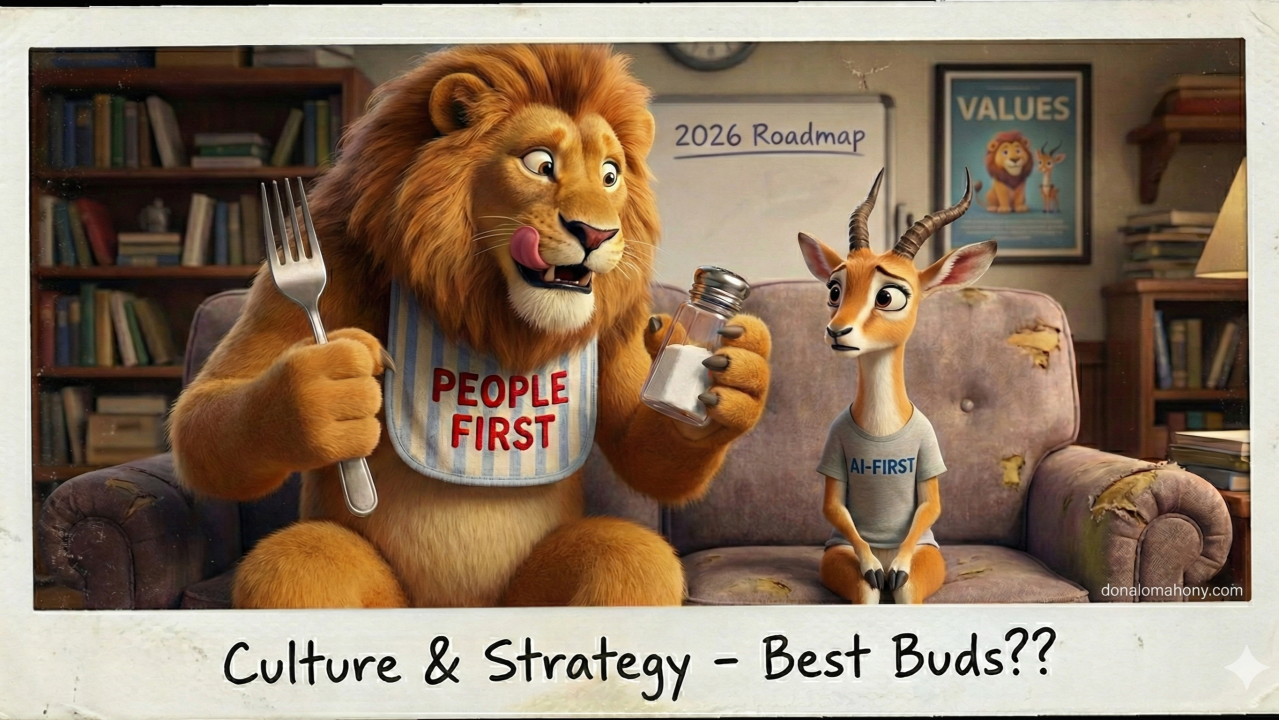
Culture eating strategy (donalomahony.com)
A few months back I was having coffee with a buddy while navigating my own next steps. As we discussed various opportunities and companies, he stopped me and said: “You are people and culture-focused. Why would you prioritise anything else in your next move?”
That was a breakthrough for me. I 100% screened them on culture, trust, fun and it worked out really well.
In a tech world obsessed with AI efficiency, with some companies gaining a reputation for moving fast and breaking people, I realised that culture isn't just a 'nice-to-have' - it is becoming the ultimate competitive advantage or talent repellent, depending on your reputation. Whether you are an individual looking for your next home or a leader building a global team, your success in 2026 will be defined by the quality of the human operating system you choose to invest in.
The Positive Trend: Moving Toward Independence
I am seeing a clear trend where experienced ICs and managers are leaving large global companies for smaller teams, friendlier startups, or starting their own local ventures. They are not looking for new titles; they are looking for agency, purpose, and the craft of shipping. In massive organisations, change often stalls because personal 1:1 communication breaks down across time zones or folks who were once central to decisions and vision are left outside of 'the room'. This creates a "Cognitive Aperture" problem. When trust is high and the "water cooler" talk is transparent, the aperture is open - teams can process complex shifts and contribute to the vision. When uncertainty and "roadmap whiplash" take over, the aperture closes. If leadership broadcasts strategy while the aperture is closed, it isn’t progress; it’s just noise.
Timeless Frameworks for High-Trust Cultures
Technology evolves exponentially, but human psychology remains constant. I’ve always aligned with Peter Drucker’s view that culture eats strategy for breakfast, but I’d add that strategy struggles to even get to the table in an environment of low trust. To reopen the team's aperture, I lean on 2 core frameworks and 1 legendary coach:
Covey’s 5th Habit (Seek First to Understand): This is the practical tool for reopening a closed aperture. When a team feels truly understood, their capacity for change increases. You cannot broadcast your way into a high-trust environment; you have to listen your way there, and you have to repeat your message (or strategy) multiple times and seek feedback along the way.
Lencioni’s ‘5 Dysfunctions of a Team’: Success relies on trust. Many companies currently practice "Artificial Harmony" - a (UX, Product or AI) theatre where everyone nods in meetings but harbours unresolved friction - aka as 'good luck with that!'. By addressing the absence of trust, we allow for the productive conflict necessary to actually digest and execute a strategy, creating the cultural appetite.
The Bill Campbell Approach: As the "Trillion Dollar Coach" famously noted, you don’t manage a product; you manage a team, and those people manage the product. Shifting from "Process-First" to "People-First" is the most effective way to drive results in an era of burnout.
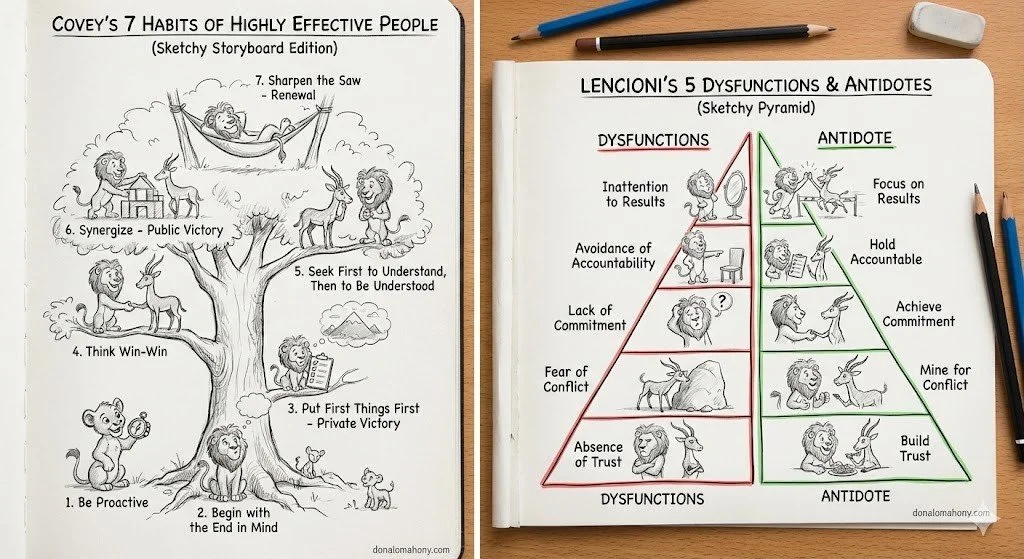
Covet's 7 Habits of Highly effective people and Lencioni's 5 dysfunctions of a team (donalomahony.com)
The Two-Way Screener
The move to a better culture is an instant restoration of creative energy. This alignment begins with the the job search (internal or external). Interviews should no longer be one-sided interrogations; they are now a mutual exploration of values.
For the candidate, this is your chance to screen for fun, high agency, and evidence of trust. Ask the hard questions: “How do you handle failure? Do people here have the autonomy to create, or just the permission to follow process? What do you do to celebrate or have fun?”. Screening for fulfilment rather than just a pay-check is how you protect your own metal health and ensure you are entering a culture that actually has an appetite for your talents.
The Path Forward: Mutual Investment
As we all navigate the uncertainty of the AI era, culture is the ultimate talent magnet. But let’s be clear: Culture is not beer taps and bean bags. Investing in culture means:
Investing in relationships: Shooting the breeze, knowing the name of a teammate’s pets, or their outside passions. Helping one another aka togetherness.
Investing in people, not just platforms: Prioritising 1:1s, mentoring or external coaching rather than just measuring the problem without fixing it, aka the engagement survey.
Building high trust: Creating environments where people feel safe enough to take the creative discussions, feedback, tangents, risks and diversity of thought that AI cannot replicate. I have seen this in action from leadership recently and the momentum that follows is exciting!
For Companies: Your culture is your recruitment brand. The best talent talk to one another (coffees and chats) and in 2026 they will flock to where they are seen as intelligentcreative people, not resources or units of output.
For Individuals: Invest in yourself by being uncompromising. Proactively get a coach (for your career and your life), screen companies (and teams) for culture and purpose, and seek out the "fun-times" of creation and shipping together.
When we prioritise the human element, we don’t just build better products; we build better teams and more fulfilled lives.
“Culture eats strategy for breakfast” Is loosely credited to Peter Drucker but first surfaces via Mark Fields, a former Ford Motor Company executive, around 2006. Since 2006 the quote been featured on a slide at almost every business conference I have ever attended. Yet, despite its ubiquity, some organisations still treat it as a footnote to the roadmap, or strategy, rather than the engine of the business.
