Above or Below the Line: A Model for Every Interaction
Somebody cuts you off in traffic. In the space of about a second, before any conscious thought arrives, the body has already decided: threat, defend, win. That reaction is not a personality trait. It's roughly two hundred thousand years of survival wiring doing exactly what it evolved to do, just badly matched to a modern commute, a Slack message, or a disagreement in a planning meeting.
The "above the line, below the line" model, widely used in leadership and conscious-leadership coaching, gives that instinct a name and, more usefully, a way out of it.
Below the line: defensive, closed, reactive, focused on being right, on winning, on who's to blame.
Above the line: open, curious, focused on learning, on what's actually true, on what happens next rather than on who caused it. Everyone spends time in both. The line isn't a character judgement, it's a state, and states move.
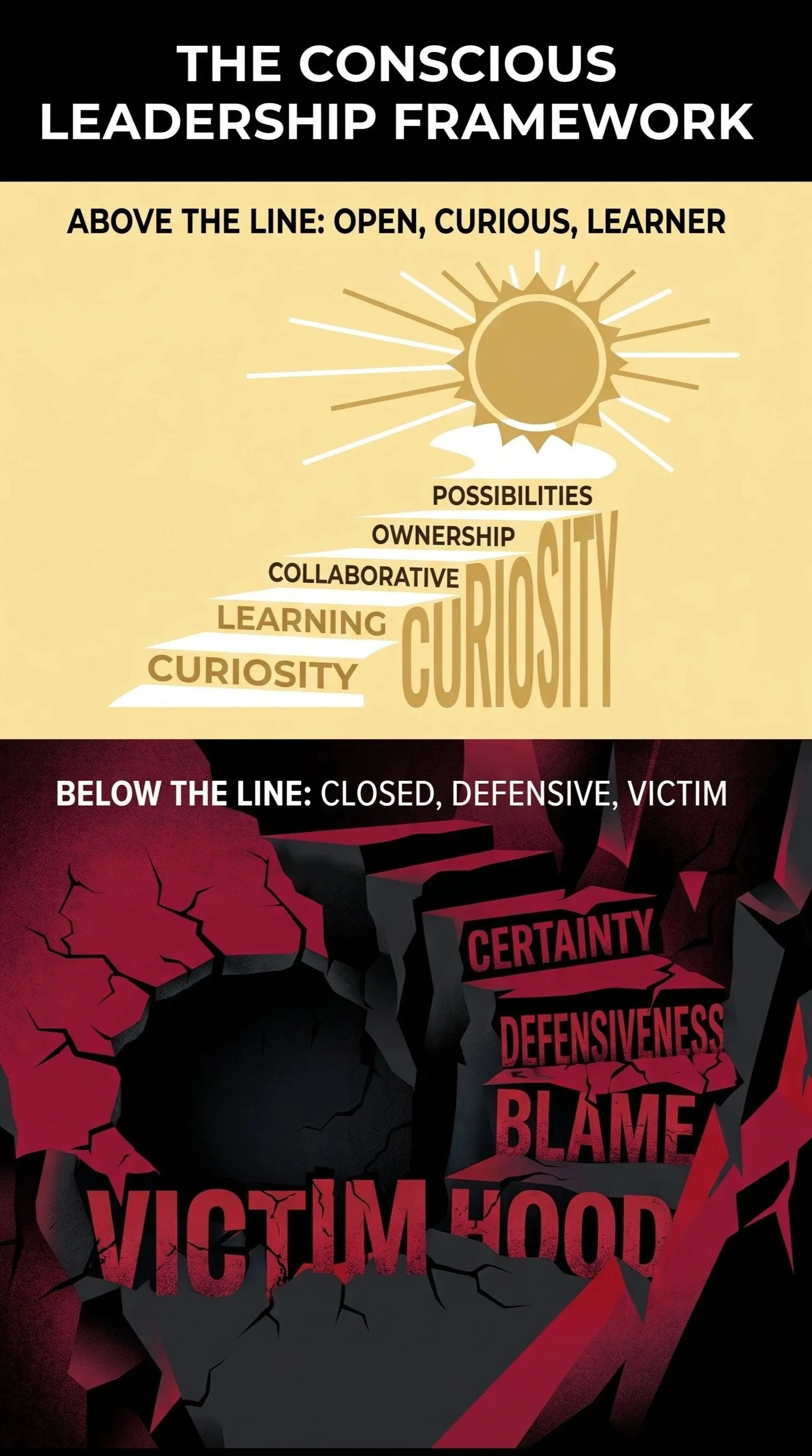
Above v Below the line leadership (Image donalomahony.com)
The primitive instinct underneath it
Below the line isn't weakness, it's biology. The brain's threat-detection system can't tell the difference between a genuine physical danger and a pointed comment in a retro, both light up the same alarm, and the alarm's job is to win or flee, not to understand. Left unchecked, that produces exactly what it evolved to produce: certainty, defensiveness, and a very fast need to be right, in a traffic jam, in a difficult 1:1, in a team that's just been told about a reorg.
Naming that mechanism is most of the battle. The moment a below-the-line reaction can be recognised as biology doing its job rather than as a fair reflection of the situation, it loses a large part of its grip.
What "above the line" actually requires
Above the line isn't the absence of the instinct, it's a deliberate override of it, and it has a fairly consistent shape wherever it shows up: curiosity instead of certainty, ownership instead of blame, a question instead of a verdict. "What am I missing here" instead of "here's what's wrong with them." It's not about staying calm for its own sake, a genuinely curious response to a threat is often more effective than a calm one, calm can still be closed.
Where the breakthrough actually happens
The interesting thing about this model isn't the theory, it's how small the moments are where it actually matters. Above the line in one high-stakes annual review is worth less than above the line in fifty ordinary Tuesday interactions, the tense stand-up, the terse email, the traffic jam. Most below-the-line moments are genuinely tiny and pass unnoticed, which is exactly why they compound. A team, a relationship, or a leader that's below the line by default in the small moments builds a below-the-line culture without a single dramatic incident ever happening. Trust erodes in the ordinary interactions, not the extraordinary ones.
The practical version is almost embarrassingly simple: notice the pull toward being right, toward winning, toward blame, and treat that noticing as the cue, not the excuse. Pause. Ask the curious question instead of stating the closed one. It won't work every time, the instinct is old and strong. But it works often enough, in enough small moments, to change the shape of a team, a relationship, or a Tuesday.
This model from Conscious Leadership comes up regularly in coaching work with leaders and teams navigating conflict, change, and everyday friction. If you'd like to explore it further, get in touch.
