Who Moved My Cheese? 🧀 A Simple Method for Dealing With Change
Every few years, something arrives that rewrites the plan. A merger, a new technology, a reorg, an AI shift nobody scheduled. The trigger changes each time. The reaction, for most people, does not.
Who Moved My Cheese?, Spencer Johnson's short parable, is still one of the clearest maps of that reaction ever written, and it's worth revisiting properly rather than as a slide someone half-remembers from a workshop. Four characters live in a maze, feeding on cheese kept in the same spot, until one day the cheese is gone. Two are mice, who simply go looking for more. Two are "littlepeople," who panic, worry, and get stuck in the thinking. One of them, eventually, moves. One does not.
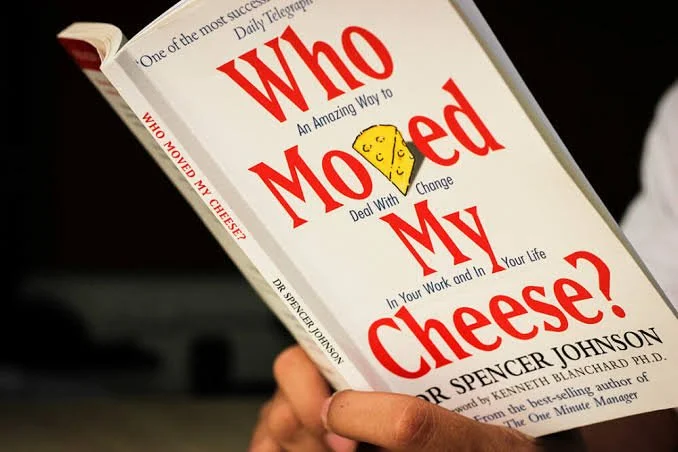
Dealing with change
The four responses, and which one is actually costing you
Strip away the maze and the cheese, and it's a map of four responses to any disruption:
Sniff the air, sense the change and go looking immediately, before the loss has even fully registered.
Sit by the empty spot and wait, sometimes for a very long time, for the old thing to reappear.
Get frightened and freeze, unable to act even once a path is obvious.
Or, eventually, notice the fear, name it, and move through it anyway.
Almost everyone recognises themselves in more than one of these, often in the same week. That's normal, and it's the point of the parable rather than a flaw in it: the disruption itself was never really the variable. How long you spend in denial, fear, or nostalgia before you move, that's the variable, and it's the one thing actually inside anyone's control.
Why the natural instinct can be the wrong instinct
Human wiring leans toward loss aversion by default, the brain treats losing something familiar as a bigger event than gaining something equally good would be, which is precisely why "what's the worst that could happen?!" arrives so much faster and so much louder than its better opposite. Undoing that lean takes real, repeated effort. One deliberate positive thought rarely offsets one automatic negative one, it tends to take two or three. That's not a character flaw, it's just the default setting, and defaults can be overridden with practice.
The breakthrough: living in the now, not the past or the future
The real shift, the one that actually changes how someone comes through a disruption, is neither mourning the old map nor anxiously redrawing the next one. It's staying with what's actually in front of you, right now, and asking a different question than fear asks by default: not "what's the worst that could happen" but "what's the best that could happen." That single flip, practised consistently rather than once, is usually what separates the people who come out of a disruption energised from the people who come out of it merely relieved it's over.
What this looks like in practice
None of this requires a crisis to apply. It shows up in a reorg, obviously, but just as often in a role that's quietly stopped fitting, a team going through a restructure, a redundancy or a technology shift nobody chose the timing of. The method is the same size regardless of the trigger: notice which of the four responses you're currently running, notice the fear underneath it, and ask what's the best that could happen instead of the worst.
Small, repeatable, and available on a Tuesday, not just in a crisis.
The cheese moves. It always does. The only real question is how long you spend standing at the empty spot before you go looking.
This framework comes up often in my coaching conversations about change and career transition. If you're navigating your own version of it right now, get in touch.
